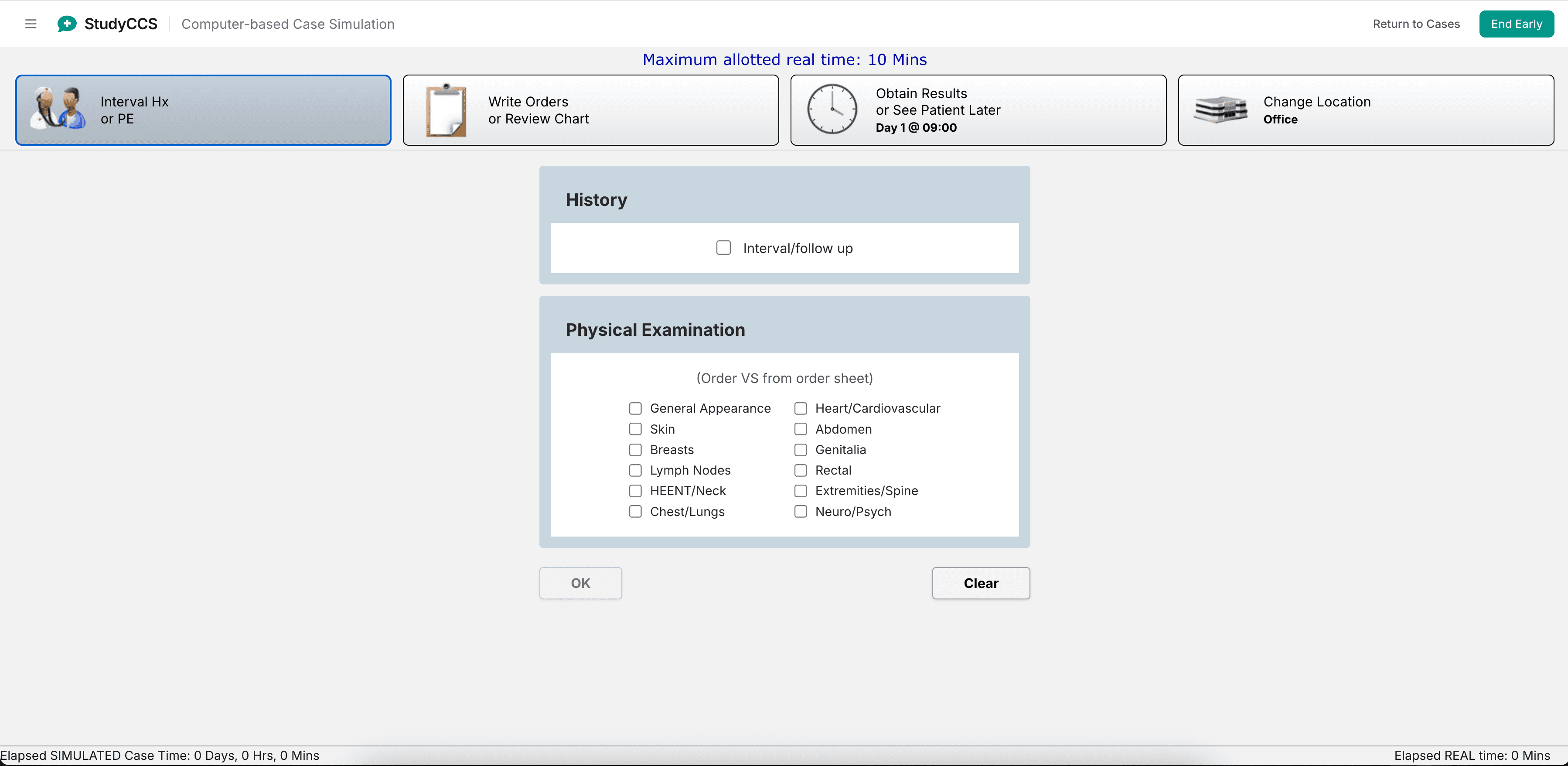
Anaphylaxis is one of the few CCS cases where the single most important order is also the first one you should place, and where hesitating for even a simulated five minutes changes the outcome. The software will happily let you order diphenhydramine, a chest X-ray, and a tryptase level while your patient's airway closes. The case is scored on whether you reached for epinephrine before you reached for anything else.
This guide walks the full CCS flow for a patient presenting with acute allergic reaction: the opening orders, the branch points that separate a routine case from a crashing one, the mimics that will burn you, and the discharge orders that most people forget to write.
Why Anaphylaxis Is High-Yield on CCS
Anaphylaxis shows up on Step 3 because it tests sequencing rather than knowledge. Almost everyone knows epinephrine treats anaphylaxis. Far fewer candidates order it as their very first action, give it by the right route, repeat it when the patient does not improve, and then remember that the patient cannot leave without an auto-injector prescription and an allergy referral.
It is also a case that can be written in several settings. An ED presentation after a bee sting, a clinic patient who reacts minutes after an injection, an inpatient reacting to a new antibiotic, or a post-contrast reaction in radiology all run the same core algorithm with different starting resources. If you are drilling by presentation, this case sits next to CCS shortness of breath and CCS asthma exacerbation, and the three are easy to confuse under time pressure.
The scoring logic rewards speed here more than thoroughness. For how that tradeoff is graded across the section, see how CCS scoring actually works.
The First 60 Seconds: Opening Orders
If the stem gives you urticaria plus any respiratory, cardiovascular, or GI involvement after an exposure, you are in anaphylaxis. Do not wait for hypotension to commit.
Order first, before the physical exam:
• Epinephrine 0.3–0.5 mg IM, anterolateral thigh (1:1000 concentration). In a child, 0.01 mg/kg IM up to 0.3 mg.
• Place patient supine with legs elevated (unless vomiting or in respiratory distress)
• Oxygen, high-flow via non-rebreather
• Pulse oximetry, continuous
• Cardiac monitor
• IV access, two large-bore lines
• Normal saline bolus, 1–2 L IV wide open
• Remove or stop the trigger (discontinue the infusing drug, remove the stinger)
Then perform: focused exam of airway, lungs, skin, and perfusion. You are looking specifically for stridor, lip or tongue swelling, wheeze, and blood pressure.
Adjuncts — order these, but never instead of epinephrine:
• Diphenhydramine 25–50 mg IV
• Famotidine 20 mg IV
• Methylprednisolone 125 mg IV
• Albuterol nebulizer, if wheezing
Advance the clock 5 minutes and reassess. Five minutes is the right interval here. Advancing 30 minutes after a single dose of epinephrine is one of the most common ways to lose this case.
Branch Points
Branch 1: Patient improves after the first dose
Blood pressure recovers, wheeze clears, swelling stabilizes. Continue fluids, keep the monitor on, and move to the observation pathway below. Do not discharge from the first reassessment.
Branch 2: No improvement at 5 minutes
Repeat epinephrine 0.3–0.5 mg IM. You can repeat every 5–15 minutes. Candidates routinely under-dose this case by giving one shot and then escalating to other drugs instead of redosing the drug that works.
Branch 3: Refractory hypotension after two or three IM doses
• Start an epinephrine IV infusion (titrated to MAP)
• Continue aggressive crystalloid
• Add a second vasopressor (norepinephrine) if still hypotensive on epinephrine drip
• Change location to ICU
Branch 4: Stridor, voice change, or tongue and lip swelling
This is the airway branch and it overrides everything else. Order endotracheal intubation early, while the airway is still passable, and have a surgical airway available. A patient with progressive angioedema who is still talking comfortably will not be talking comfortably in fifteen simulated minutes. Call anesthesia or ENT.
Branch 5: Patient is on a beta-blocker and epinephrine isn't working
Beta blockade blunts the response to epinephrine. Add glucagon 1–5 mg IV. This is a classic CCS discriminator and the stem will usually hand you the beta-blocker in the medication list.
Branch 6: Angioedema with no urticaria and no clear trigger
Stop and reconsider the diagnosis. Isolated facial, lip, or tongue swelling without hives, especially in a patient on an ACE inhibitor, is bradykinin-mediated angioedema, not histamine-mediated anaphylaxis. Epinephrine, antihistamines, and steroids do not reliably reverse it. Protect the airway, stop the ACE inhibitor, and for hereditary angioedema order C1 esterase inhibitor concentrate or icatibant.
Don't-Miss Diagnoses and Case-Killers
1. Delaying epinephrine. Giving diphenhydramine and steroids first, or waiting for IV access before giving IM epinephrine, is the single most penalized action in this case.
2. Wrong route. Subcutaneous epinephrine has unreliable absorption in a hypotensive patient. IM into the thigh is the answer. IV push epinephrine in a patient with a pulse risks arrhythmia — that is an infusion, not a bolus.
3. ACE-inhibitor or hereditary angioedema. Treating it as anaphylaxis and never securing the airway.
4. Biphasic reaction. Discharging at two hours because the patient looks well. Symptoms can recur hours after apparent resolution.
5. Beta-blocker resistance. Escalating pressors while never adding glucagon.
6. Mimics. Vasovagal syncope after an injection (bradycardic, pale, no urticaria), scombroid fish poisoning, and systemic mastocytosis all present with flushing. If an exposure history and hives are absent, widen the differential rather than committing. Ingestion-driven presentations may belong closer to CCS toxicology.
7. Forgetting the discharge orders. A perfectly resuscitated patient sent home without an auto-injector still loses points.
The Complete Order Set and Disposition
Immediate:
• Epinephrine 0.3–0.5 mg IM (repeat q5–15 min as needed)
• Oxygen, high-flow
• Pulse oximetry, continuous
• Cardiac monitor
• IV access ×2, large bore
• Normal saline 1–2 L IV bolus
• Supine positioning, legs elevated
• Discontinue the offending agent
Medications:
• Diphenhydramine 25–50 mg IV
• Famotidine 20 mg IV
• Methylprednisolone 125 mg IV
• Albuterol nebulizer, for bronchospasm
• Glucagon 1–5 mg IV, if on beta-blocker
• Epinephrine infusion, if refractory
Airway:
• Endotracheal intubation, for stridor or progressive angioedema
• Anesthesia or ENT consult
Labs and studies — low priority, and never before epinephrine:
• CBC, BMP
• Serum tryptase (supports the diagnosis retrospectively; does not change acute management)
• EKG, if chest pain or known coronary disease
Monitoring:
• Vital signs q15 min
• Observe 4–6 hours minimum after symptoms resolve, longer if the reaction was severe or required repeat dosing
Disposition:
• ICU — refractory hypotension, intubated airway, or epinephrine infusion
• Observation unit or floor — required repeat epinephrine dosing, or significant comorbidity
• Discharge home — single dose, full resolution, completed observation window
Discharge orders — write all of these:
• Epinephrine auto-injector, prescription for two, with demonstration and counseling
• Oral antihistamine and oral prednisone taper, 3–5 days
• Written anaphylaxis action plan
• Allergy and immunology referral
• Trigger avoidance counseling
• Medical alert identification
• Return precautions and follow-up appointment, 1–2 weeks
If you tend to lose points at the end of cases rather than the beginning, the same discharge logic is laid out across presentations in the CCS preventive care and discharge cheat sheet.
Related Guides
• CCS Shortness of Breath: Complete Approach & Order Sets
• CCS Asthma Exacerbation: Severity Assessment to Discharge
• CCS First 60 Seconds: Opening Algorithms
• CCS Preventive Care & Discharge Cheat Sheet
• Step 3 CCS Guide: Scoring, Timing & Strategy (2026)
Anaphylaxis rewards reflex, not deliberation, and reflex only comes from reps. Run it under a clock with practice CCS cases, and drill the opening sequence itself with SpeedOrder until epinephrine IM is the first thing your hands type.