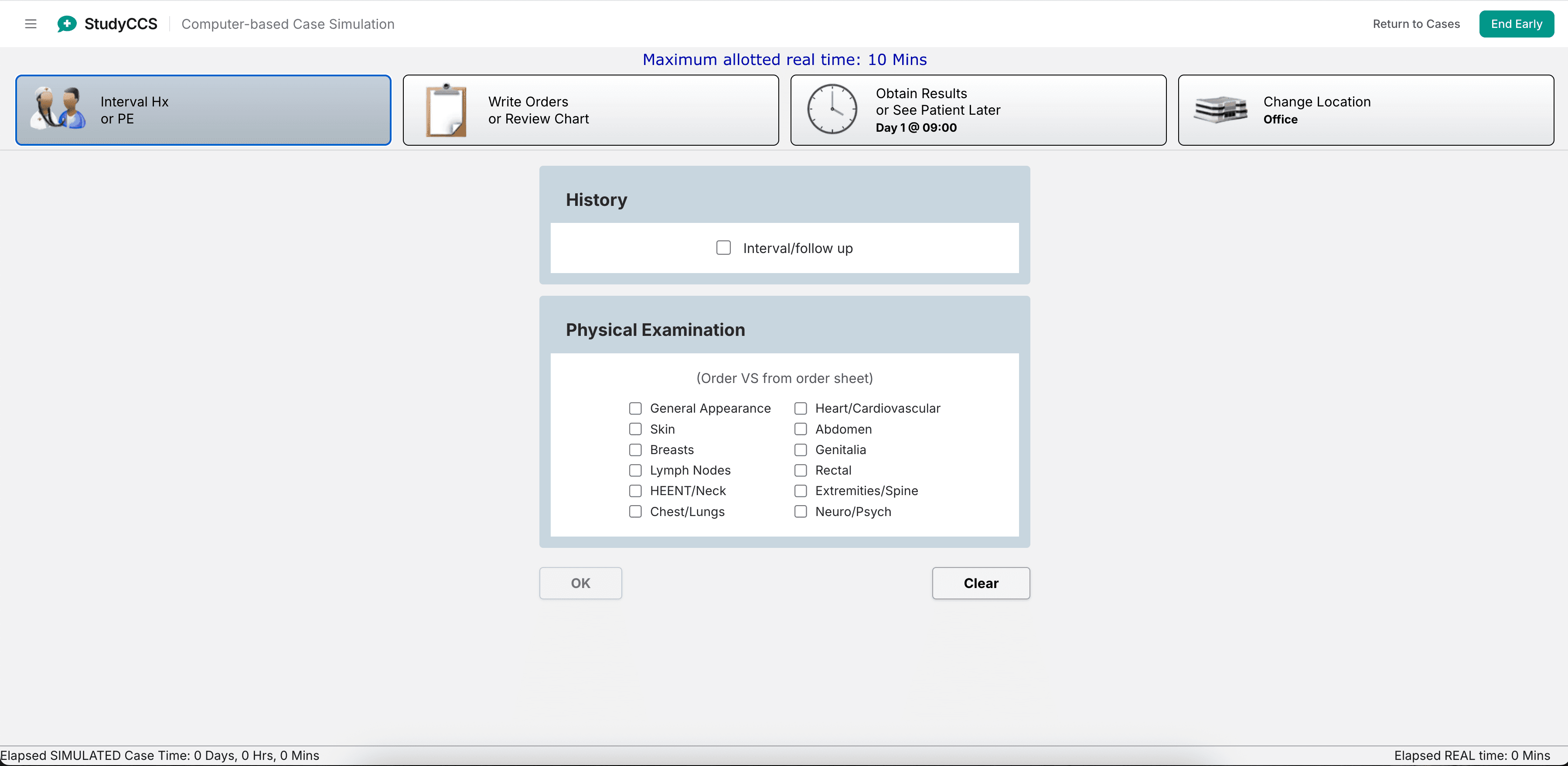
Endocrine emergencies are a favorite case-simulation setup because they hide inside presentations you have already practiced. Thyroid storm arrives as atrial fibrillation with fever. Myxedema coma arrives as hypothermia and altered mental status. Adrenal crisis arrives as hypotension that does not respond to the fluids you just ordered.
In every one of them, the diagnosis is clinical and the treatment cannot wait for the confirmatory labs. That is the whole test. If you order the TSH and then sit on your hands waiting for it to come back, the clock advances and the patient deteriorates while your orders are technically reasonable and completely insufficient.
Why these presentations are high-yield
Three features make endocrine emergencies ideal case material. First, treatment precedes confirmation, which separates candidates who treat patients from candidates who order tests. Second, each one has a sequencing trap that is genuinely wrong if you get it backwards, so partial credit is hard to collect by shotgunning orders. Third, each has a precipitant you are expected to find and treat, which means the case rewards you for ordering a workup alongside the treatment rather than instead of it.
They also sit next to presentations we cover separately. If the stem reads as undifferentiated confusion, work through altered mental status first. If it reads as fever and hypotension, start with fever and sepsis. Endocrine should be the diagnosis you reach when the vitals and the exam do not fit the usual pattern.
First 60 seconds: the opening orders
Before you commit to which endocrine emergency you are in, the opening block is nearly identical and buys you the data to branch. In the emergency department, order:
• IV access, two large-bore
• Continuous pulse oximetry and cardiac monitor
• Vital signs including rectal or core temperature
• Fingerstick glucose — immediately, not as part of the panel
• CBC with differential, CMP, magnesium, phosphate
• TSH, free T4
• Serum cortisol — draw it before you give any steroid
• EKG
• Chest X-ray
• Urinalysis and urine culture, blood cultures
• Normal saline IV bolus
Two of those orders matter more than they look. The fingerstick is separate because hypoglycemia is both a cause of altered mental status and a feature of adrenal crisis, and you do not want to wait on a chemistry panel for it. The cortisol level drawn before steroids is the one piece of diagnostic information you destroy by treating, so it goes in first — and then you treat anyway.
The cultures and chest film are not padding. Infection is the most common precipitant across all three of these, and a case that you treat correctly but never work up for a trigger is an incomplete case. The same opening-block logic for any presentation is laid out in the first-60-seconds algorithms.
Branch point 1: Thyroid storm
You are here when you have fever, tachycardia out of proportion to the fever, agitation or delirium, and often a new atrial fibrillation, plus a goiter, exophthalmos, or a history of Graves disease. Gastrointestinal symptoms and a wide pulse pressure are common. The diagnosis is clinical; a severity score supports it but does not gate treatment.
The treatment has four parts and the order matters:
• Beta blocker first. Propranolol IV, titrated to heart rate. It controls the adrenergic symptoms and, at higher doses, blunts peripheral conversion of T4 to T3. Esmolol is the alternative if you want something titratable in an unstable patient.
• Thionamide second. Propylthiouracil is preferred over methimazole here, because it also blocks peripheral conversion. This stops new hormone synthesis.
• Iodine third, and at least an hour after the thionamide. Potassium iodide or Lugol solution blocks release of stored hormone. Give it before the thionamide has taken effect and you supply substrate for more hormone synthesis. This is the classic sequencing trap.
• Glucocorticoid. Hydrocortisone IV. It reduces peripheral conversion and covers the possibility of coexisting adrenal insufficiency.
Then the supportive layer: active cooling with a cooling blanket, acetaminophen for fever, IV fluids, and treatment of the precipitant. Do not reach for aspirin to bring the fever down — it displaces thyroid hormone from its binding protein and raises the free fraction.
If the case gave you new atrial fibrillation, treat the storm and manage the rhythm; rate control is already underway with the propranolol. The anticoagulation decision follows the usual logic covered in atrial fibrillation.
Branch point 2: Myxedema coma
This is the mirror image: hypothermia, bradycardia, hypoventilation with CO2 retention, non-pitting edema, delayed reflex relaxation, hyponatremia, hypoglycemia, and depressed mental status. The patient is often elderly, often has a thyroidectomy scar or a history of levothyroxine they stopped taking, and often got here after an infection or a cold exposure.
The sequencing trap here is the opposite one, and it is the single highest-yield fact in this guide:
• Hydrocortisone IV before thyroid hormone. If the patient has unrecognized adrenal insufficiency, giving thyroid hormone first accelerates cortisol metabolism and can precipitate adrenal crisis. Steroid first, every time.
• Then IV levothyroxine, as a loading dose followed by daily dosing. Some add liothyronine; the exam-safe answer is IV levothyroxine with the steroid already running.
• Passive external rewarming. Warm blankets, warm room. Aggressive active rewarming causes peripheral vasodilation and worsens the hypotension.
• Airway support. These patients hypoventilate. Check an arterial blood gas and intubate for hypercapnic respiratory failure rather than waiting for them to tire out.
• Correct the glucose and treat the precipitant. Dextrose for hypoglycemia, empiric antibiotics if there is any suggestion of infection.
Fluid management needs restraint. The hyponatremia here is usually dilutional and improves with thyroid hormone and free water restriction, so pouring in hypotonic fluid works against you. Hypertonic saline is for seizures or severe symptomatic hyponatremia only — the thresholds are in electrolyte emergencies.
Branch point 3: Adrenal crisis
The tell is hypotension that does not correct with volume. Add hyponatremia with hyperkalemia, hypoglycemia, abdominal pain, nausea, and either chronic steroid use that stopped abruptly or hyperpigmentation suggesting primary disease. Fever is common. The patient may be in crisis because of an infection, a surgery, or a missed dose during an illness.
Treatment is short and you should not hesitate:
• Hydrocortisone IV, 100 mg, now. Draw the cortisol and ACTH first if you can do it in the same moment, but do not delay the steroid for the lab. If the team plans a cosyntropin stimulation test, dexamethasone is the steroid that does not interfere with the cortisol assay.
• Aggressive isotonic fluid. Normal saline, large volume, reassessing perfusion as you go.
• Dextrose for hypoglycemia, often as D5 normal saline once the bolus is in.
• Treat the hyperkalemia if the EKG shows changes, and recheck the potassium after the steroid and fluids, because it often corrects on its own.
• Find and treat the precipitant. Cultures, imaging, antibiotics if indicated.
Mineralocorticoid replacement is not an acute priority: hydrocortisone at stress doses has enough mineralocorticoid activity, and the saline is doing the volume work.
Don't-miss diagnoses
Four things to keep on the list while you treat:
• Concurrent adrenal insufficiency in any thyroid emergency. This is why hydrocortisone appears in all three order sets. Autoimmune thyroid disease and autoimmune adrenal disease travel together.
• The precipitant you never looked for. Infection, myocardial infarction, missed medication, recent surgery, or a new drug. Treating the endocrine emergency without identifying the trigger leaves the case incomplete.
• Sepsis masquerading as storm, or storm masquerading as sepsis. Fever, tachycardia, and altered mentation fit both. Culture and cover while you treat the endocrine picture.
• Hypoglycemia as the real cause of the altered mental status. It is one fingerstick and it is free.
Complete order set and disposition
Once you have branched, the disposition is the same in all three: these patients go to the intensive care unit. Not the floor, not observation. Move them early rather than waiting for the labs to confirm what you already decided clinically.
A consolidated set for the stable-enough-to-transfer patient:
• ICU admission, continuous cardiac and pulse oximetry monitoring
• Strict intake and output, daily weights, frequent neurologic checks
• The emergency-specific drugs above, with the sequence preserved
• Normal saline at a maintenance or resuscitative rate, adjusted to the picture
• Dextrose if hypoglycemic; recheck fingerstick on a schedule
• Empiric antibiotics if infection is suspected, after cultures
• Repeat CMP and magnesium in 6 to 12 hours
• Endocrinology consultation
• Hold the medication that caused the problem, or restart the one that was stopped
Before you end the case, do the final sweep: have you re-dosed anything that needed a second dose, ordered the follow-up labs, moved the patient to the right location, and addressed the precipitant? That last pass is covered in the final two-minute screen, and the consult timing logic is in when to call a consult.
These three cases reward practice more than reading, because the failure mode is almost always sequence rather than knowledge. Run one under a clock with a free practice case and see whether the steroid goes in before the levothyroxine when you are the one typing the orders.