How to use this cheat sheet
Review this the night before your exam. The goal is not to memorize — it is to prime your brain on the patterns and default orders so they come automatically on exam day. Print it or bookmark it.
The 5 patterns every CCS case follows
Regardless of chief complaint, every CCS case follows one of these five patterns. Recognizing the pattern in the first 30 seconds determines your entire approach:
| Pattern | Setting clues | First move |
|---|---|---|
| Emergent (unstable) | Abnormal vitals, acute distress, ER setting | ABCs → IV + monitor → focused exam → stat labs |
| Acute but stable | Normal vitals, ER or floor | Focused exam → initial workup → treat → monitor |
| Outpatient new complaint | Office setting, weeks–months history | Complete exam → workup → treat/counsel → follow-up |
| Outpatient chronic management | Office setting, known diagnosis | Review adherence → labs → adjust meds → preventive care |
| Inpatient complication | Post-op, floor patient deteriorating | Stat vitals → EKG/CXR/labs → narrow differential fast |
The universal order sequence (works for every case)
Apply this sequence to any case. Skip steps that are clearly not applicable, but never skip them without a reason.
Step 1 — Stabilize (if needed): IV access · Cardiac monitor · Pulse oximetry · O2 if SpO2 < 94% · Fingerstick glucose (any AMS or emergency) · Transfer to appropriate location
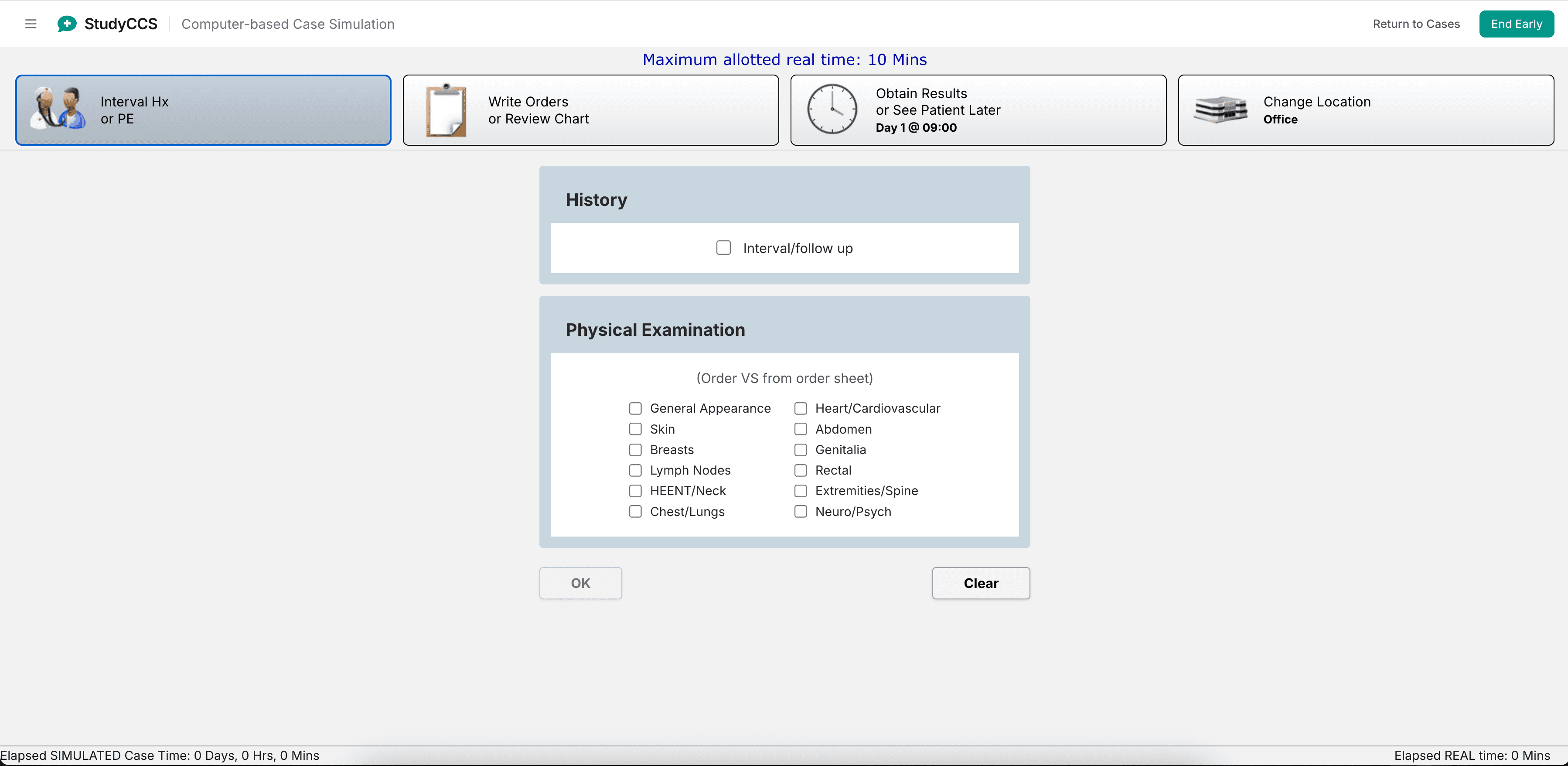
Step 2 — Physical exam: Focused (emergent) or Complete (stable/outpatient) · Never skip entirely
Step 3 — Initial labs (always order unless clearly irrelevant): CBC · BMP · UA · Pregnancy test (any woman of childbearing age) · EKG (any cardiac/chest/AMS complaint)
Step 4 — Advance clock: 15–30 min for emergent; 1–2 hours for stable; longer for outpatient
Step 5 — Targeted workup: Based on differential after Step 4 results
Step 6 — Treat: Start obvious treatment early — don't wait for all results
Step 7 — Monitor: Recheck vitals · Repeat key labs · Interval history/exam · Adjust location if needed
Step 8 — 2-minute screen: Follow-up appointment · Preventive care (vaccines, cancer screening) · Counseling (diet, smoking, activity) · Future labs
Must-order labs by chief complaint
| Chief complaint | Don't forget to order |
|---|---|
| Chest pain | EKG (stat) · Serial troponins · CXR · D-dimer if PE suspected · BNP if heart failure suspected |
| Shortness of breath | CXR · ABG (if severe) · BNP · Peak flow (asthma/COPD) · D-dimer if PE · Spirometry (outpatient) |
| Abdominal pain | LFTs · Lipase · UA · Pregnancy test · Upright CXR (free air) · RUQ ultrasound or CT abdomen |
| Altered mental status | Fingerstick glucose (first!) · Blood cultures · LP (if meningitis suspected) · CT head · TSH · Ammonia · Urine tox screen |
| Fever / sepsis | Blood cultures × 2 (before antibiotics) · UA + urine culture · CXR · Lactate · CBC + BMP |
| GI bleeding | Type and crossmatch · PT/INR · Liver function tests · Gastroenterology consult · NPO |
| Headache | CT head (rule out bleed first if thunderclap or focal neuro signs) · LP (if CT negative and meningitis/SAH suspected) · ESR (if > 50 y/o, rule out GCA) |
| Stroke / focal neuro | CT head (non-contrast, stat) · Finger stick glucose · EKG · Echo · CBC + coags · Neurology consult |
| Diabetic emergency (DKA) | ABG · Serum ketones · Phosphorus · Magnesium · IV fluids (NS) · Insulin drip · Monitor K+ every 1–2h |
| Well-child / prenatal visit | Age-appropriate vaccines · Developmental screening · Lead screening (12–24 months) · GBS culture (35–37 weeks) · Group B strep |
CCS mnemonics
ABCDE (Stabilization sequence):
Airway — secure it · Breathing — O2, ventilate · Circulation — IV access, fluids, pressors · Disability — neuro check, glucose · Exposure — full exam, temperature
SMURF (2-minute screen memory cue):
Schedule follow-up · Medications — reconcile, add discharge meds · Updated preventive care (vaccines, cancer screening) · Refer (specialist follow-up) · Future labs (e.g., HbA1c in 3 months)
FAST (stroke recognition orders):
CT head non-contrast · FAST exam · Aspirin (only if hemorrhagic ruled out) · Stroke team / neurology consult · tPA window assessment (within 3–4.5 hours of symptom onset)
MOVE IT (sepsis bundle — first hour):
Measure lactate · Obtain blood cultures (×2 before antibiotics) · Volume — 30 mL/kg IV crystalloid bolus · Empathic antibiotics — broad spectrum IV · ICU transfer if hypotensive or lactate > 4 · Target MAP ≥ 65 with vasopressors if needed
20-minute CCS case time template
For a typical 20-minute case (most common on Step 3), distribute your real time like this:
| Real time | Action | Sim clock advance |
|---|---|---|
| 0:00–1:30 | Read case, note vitals, place immediate orders | 0 min |
| 1:30–3:00 | Physical exam + review first result batch | 15–30 min |
| 3:00–7:00 | Interpret results, narrow diagnosis, initiate treatment | 1–2 hrs |
| 7:00–12:00 | Monitor, recheck vitals, adjust treatment, move patient if improving | 4–24 hrs |
| 12:00–17:00 | Disposition — discharge home or step down; discharge meds | 1–3 days |
| 17:00–20:00 | 2-minute screen — preventive care, follow-up, counseling | — |
Top 10 things examinees forget to order
These are the most commonly missed orders that cost points — check every case against this list before advancing the clock for the last time:
- Follow-up appointment — always schedule before ending the case
- Age-appropriate cancer screening — colonoscopy (≥45), mammogram (≥40), Pap smear (21–65)
- Vaccines — flu (annual), pneumococcal (≥65 or high-risk), Tdap, HPV (≤26)
- Smoking cessation counseling — any smoker, every case
- Repeat key labs — troponin at 3+6h, CBC after transfusion, K+ during insulin drip
- Monitoring orders — vital signs q4–8h, telemetry, I&Os
- Pregnancy test — every woman of childbearing age, every ER case
- Discharge medications — all chronic meds plus new discharge prescriptions
- Diet counseling — low-sodium (heart failure, HTN), diabetic diet, low-fat
- Physical exam on first advance of the clock — skipping it costs points even with correct orders
High-yield CCS preventive care quick reference
| Intervention | Who / when |
|---|---|
| Colonoscopy | Age ≥ 45, every 10 years |
| Mammogram | Women ≥ 40, every 1–2 years |
| Pap smear | Women 21–65; every 3 years alone or 5 years with HPV co-test |
| Lung cancer CT | 50–80 y/o, ≥20 pack-year history, currently smoking or quit < 15 years ago |
| Influenza vaccine | Everyone ≥ 6 months, annually |
| Pneumococcal vaccine | Age ≥ 65, or < 65 with high-risk condition |
| Shingles (Shingrix) | Age ≥ 50 (2 doses) |
| Abdominal aortic aneurysm screen | Men 65–75 who have ever smoked — one-time abdominal ultrasound |
| Depression screening | All adults; PHQ-2 / PHQ-9 |
Related articles:
• Step 3 CCS Guide: Scoring, Timing & Strategy (2026)
• CCS Preventive Care & Discharge Cheat Sheet
• CCS First 60 Seconds Algorithms for Every Setting
• CCS Mistakes That Cost You Points
• CCS Case Mnemonics on Reddit: The Ones Test-Takers Swear By