Most people practice case simulations as a list of orders: what to give, what to check, what to rule out. Then they lose points on something they never thought of as a clinical decision at all — leaving the patient in the wrong place.
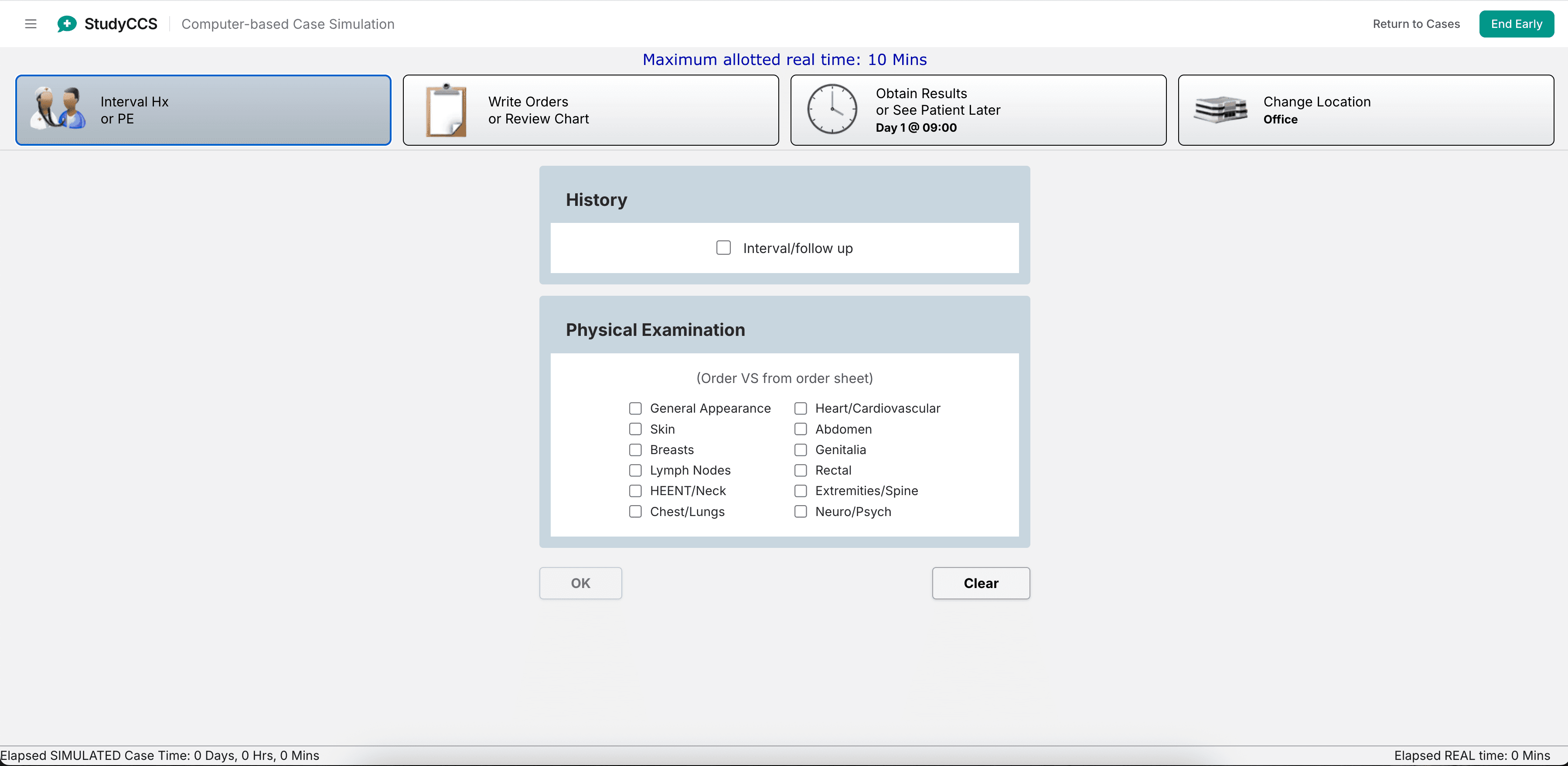
Where the patient is sitting is a scored decision. The emergency department, the ward, the intensive care unit, and home are four different answers, and the case expects you to pick the right one and to move the patient when the picture changes. This guide covers the triggers for each move, what to re-order after you make it, and the location mistakes that quietly cost points.
Why location is a clinical decision, not bookkeeping
Two reasons it matters more than it seems. First, location gates what you can do: you cannot run a continuous insulin infusion with hourly glucose checks on a patient you left in the waiting room, and the case knows it. Second, moving the patient advances the clock in a structured way, which means a transfer is also a pacing tool. Use it deliberately rather than treating it as paperwork you do at the end.
The common failure is not picking the wrong location once. It is picking a defensible location at minute two and never revisiting it, while the patient's trajectory changes underneath you. The clock-management side of this is covered in time management; this guide is about the destination rather than the pace.
The four locations and what each one signals
Think of each location as a statement about how sick you believe the patient is and how often you intend to look at them.
• Emergency department. You are stabilizing and you do not yet know the disposition. Appropriate for the opening block of almost every acute case. Staying here too long is the problem, not starting here.
• Ward or inpatient floor. The patient needs admission, intravenous therapy, or monitoring more often than an outpatient can get, but is hemodynamically stable and not at risk of needing an airway or a drip titrated to pressure.
• Intensive care unit. Any vasopressor, any ventilator, any drip titrated minute to minute, any airway you are worried about, any rhythm you need watched continuously, any patient you expect to deteriorate in the next few hours.
• Home, or clinic follow-up. The diagnosis is made or excluded, the treatment is oral, and the patient has a follow-up plan and the ability to return. Discharge is an active order set, not an absence of orders.
Emergency department to the ICU: the triggers
Do not wait for the patient to look terrible. Move when any of these appear, and move before you finish the rest of the workup:
- Hypotension that has not responded to initial fluid resuscitation, or any decision to start a vasopressor.
- Respiratory failure or an airway you are watching — rising CO2, falling saturations on escalating oxygen, or depressed mental status that threatens airway protection.
- Any infusion requiring titration: insulin for diabetic ketoacidosis, nitroglycerin or nicardipine for a hypertensive emergency, amiodarone for an unstable rhythm, heparin in a tenuous patient.
- Altered mental status with an unstable cause, or a patient you expect to need frequent neurologic checks.
- An endocrine or metabolic emergency that needs hourly labs, including the thyroid and adrenal crises.
- A rhythm or ischemic picture needing continuous monitoring beyond what the floor provides.
When in doubt in an unstable patient, the intensive care unit is the safer answer and rarely the penalized one. The reverse error — a patient on a titrated drip sitting on the ward — is harder to defend.
Emergency department to the ward
This is the right move when the patient clearly needs to be in the hospital but is stable: community-acquired pneumonia needing intravenous antibiotics, pyelonephritis with vomiting, a cellulitis that failed oral therapy, a heart failure exacerbation responding to diuresis, pain or dehydration needing a day of support. Stable vitals after your initial treatment, a clear plan, and nothing that needs titrating.
Two things people forget at this transfer. Re-check the vitals after the move and before you commit to the next set of orders, because the case may have changed something. And write the admission orders as a complete set rather than assuming the emergency department orders follow the patient upstairs — diet, activity, intravenous fluids, medications, monitoring frequency, and the labs you want in the morning all need to be stated.
Ward to the ICU: the escalation you are expected to catch
Some cases are built around this move. The patient is admitted looking stable, you advance the clock, and the interim update tells you the blood pressure dropped, the oxygen requirement climbed, or the mental status changed. The expected behavior is not to add one more order on the floor — it is to recognize the deterioration, escalate the level of care, and treat.
When you get an interim update with worse vitals, do three things in this order: re-examine the patient, move the location if the numbers meet any ICU trigger above, and then order the intervention. Candidates who order the intervention and skip the move leave points on the table, because the case is testing whether you matched the setting to the severity.
Discharging the patient: an active order set
Going home is the location people treat most casually, and it carries the most orders. A discharge that is just "discharge patient" is incomplete even when sending the patient home is the right call. You owe:
- The medications, including the full outpatient course and anything to stop.
- Follow-up with a named interval and setting — clinic in one week, repeat labs in three days.
- Counseling and risk-factor work: smoking cessation, alcohol counseling, diet, medication adherence, return precautions.
- The preventive items that the case has been waiting for you to order, which are the easiest points in the whole exercise.
Our preventive care and discharge guide is the companion to this section, and the CCS cheat sheet has the short version you can hold in your head.
The four location mistakes that cost points
- Never moving. Running an entire case in the emergency department because the opening orders kept you busy. If the patient needs admission, admit them.
- Moving before stabilizing. Transferring a hypotensive patient to the floor to "get them admitted" instead of resuscitating first and then choosing the right destination.
- Forgetting to re-order after the move. Treating the transfer as administrative and leaving the patient without a diet, fluids, monitoring, or scheduled labs in the new setting.
- Discharging without the counseling. Right disposition, incomplete order set. Also the cheapest points to recover.
A broader catalog of these is in mistakes to avoid.
Practicing the location decision specifically
You can drill this on its own. Take any case you have already worked through and ask, at each interim update, whether the patient is in the right place and what you would have to re-order if you moved them. Then run a fresh case and make the location decision out loud before you type the clinical orders, so the destination is a deliberate choice rather than something you notice at the end.
Try it on a free practice case, or work through the ordering mechanics in the case simulator. Entering the transfer and admission orders quickly is its own skill, and speed order practice is where that gets faster.