You took the Free 137, you have a percent correct, and now you are staring at a block of question numbers you got wrong with no idea what to do next. That list is the most useful thing you own right now, and most people waste it by reading explanations once and moving on.
This is a review method, not a score calculator. The goal is to turn every miss into a named reason, then turn those reasons into the two or three things you actually change for the rest of your prep. It takes about ninety minutes and it is the difference between a practice exam and a diagnostic.
Why the review matters more than the number
The percent correct tells you roughly where you stand. It does not tell you why, and it cannot tell you what to do tomorrow. Two people can miss the same number of questions for completely different reasons: one is short on pharmacology recall, the other knows the material but keeps picking the answer that is correct in isolation rather than the next best step for the patient in front of them.
Those two people need opposite study plans. If you skip the review and just drill more questions, you will keep making the same category of error at the same rate. If you want the score interpretation side of this, read what your Free 137 score actually means first, then come back and do the work below.
Step 1: Give every miss one of four labels
Go through your wrong answers one at a time. Do not read the explanation yet. Look at the stem again and decide, honestly, which of these applies:
- Knowledge gap. You did not know the fact. You had never learned it, or you had forgotten it completely. No amount of test strategy would have saved you.
- Misread the stem. You knew the content but missed a detail that changed the answer: the age, the duration, the vital sign that was abnormal, the word "initial" or "most likely," a medication already on the list.
- Next-step error. You identified the diagnosis correctly and then chose a step that was reasonable but not the right one at that moment. You confirmed when you should have treated, or treated when you should have confirmed.
- Careless. You knew it, you read it right, and you clicked the wrong thing or rushed because you were watching the clock.
Write the label next to each question number. Only after every miss has a label do you go read the explanations. Reading first contaminates the labeling, because every explanation makes the answer feel obvious in hindsight.
Step 2: Count the labels and read the pattern
Now total them up. The shape of that tally is your study plan, and the four shapes mean four different things:
- Mostly knowledge gaps. Your problem is content, and content is the easiest thing to fix with time. Keep doing questions, but start keeping a running list of the specific topics and review it on a schedule instead of hoping repetition catches them.
- Mostly misreads. You do not need more content. You need a slower, more deliberate first pass through each stem. Practice naming the patient, the time course, and the question being asked out loud before you look at the options.
- Mostly next-step errors. This is the one that matters most for the second day of the exam, and it is the one people most often mislabel as a knowledge gap. Management sequencing is a separate skill from recall, and it is exactly what case simulations test.
- Mostly careless. Your pacing is off. You are either rushing blocks you have time for or burning time early and panicking late.
Step 3: Translate next-step errors into case practice
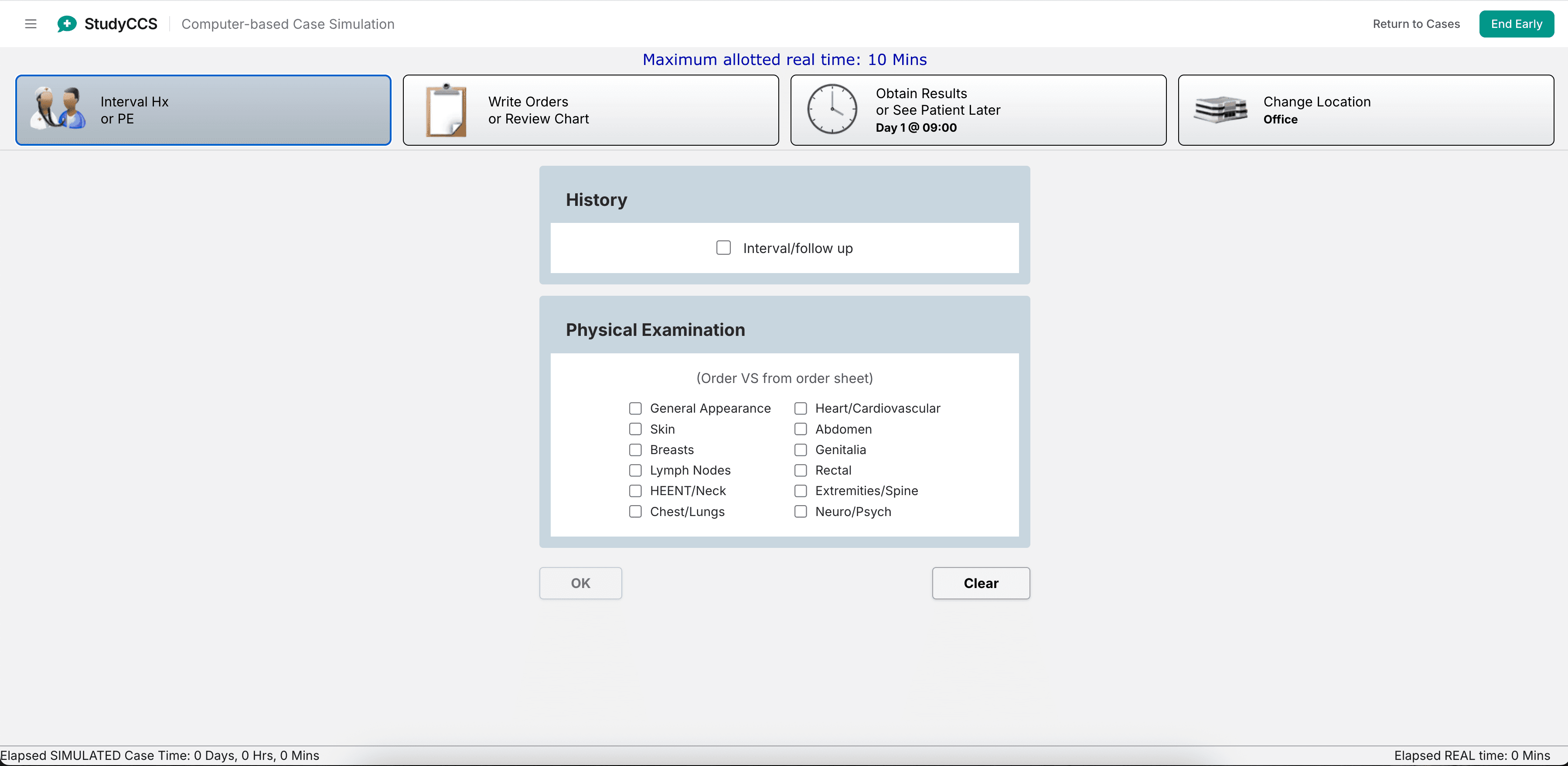
If next-step errors are a real share of your misses, that is a signal worth acting on, because the written questions let you recognize the right answer from a list. The simulations do not. You have to produce the order yourself, in the right order, and advance the clock at the right time.
For each next-step error, write one sentence: what you did, what you should have done, and what about the patient should have told you. "I ordered a CT before giving fluids in a hypotensive patient" is a usable lesson. "Review sepsis" is not. Then go run cases where that decision shows up, so the correction happens under a clock instead of on paper. The full framework for the case simulations walks through how that ordering logic works.
Step 4: Build a one-week correction block
Do not rebuild your whole schedule. Pick one week and give each day a job based on your tally:
- Two days on your single biggest content category, using your topic list rather than a textbook chapter.
- Two days of timed case practice if next-step errors were your pattern, one case per sitting, reviewing each one before you start the next.
- One day of mixed questions with a deliberate slow first read, specifically to attack misreads.
- One day off, or light review. A seventh consecutive study day during a clinical week is where careless errors come from.
If you are fitting this around clinical duties, the case study schedule has a realistic version of this block.
Step 5: Re-test without fooling yourself
Do not immediately retake the same form. You will score higher and learn nothing, because you will be remembering questions rather than reasoning through them. Let at least two weeks pass, and use a different question source in between. When you do a second timed assessment, label the misses again and compare the shape of the tally, not the percent correct. If your next-step errors dropped and your knowledge gaps stayed flat, the correction block worked and you know what to do with the next one.
Guidance on where this assessment belongs in your timeline is in how to use the Free 137, and you can find the question sets themselves on our Free 137 tools page.
What not to do with your wrong answers
Three habits waste the whole exercise:
- Making flashcards out of every explanation. You end up with a deck full of facts you already knew and no record of the reasoning errors.
- Counting only the questions you got wrong. Flag the ones you got right by guessing too. Those are knowledge gaps that happened to land.
- Treating one assessment as a verdict. It is a snapshot of one morning. The tally is signal; the exact number has noise in it.
When you are ready to pressure-test the management side under a clock, start with a free practice case and label your errors there the same way.