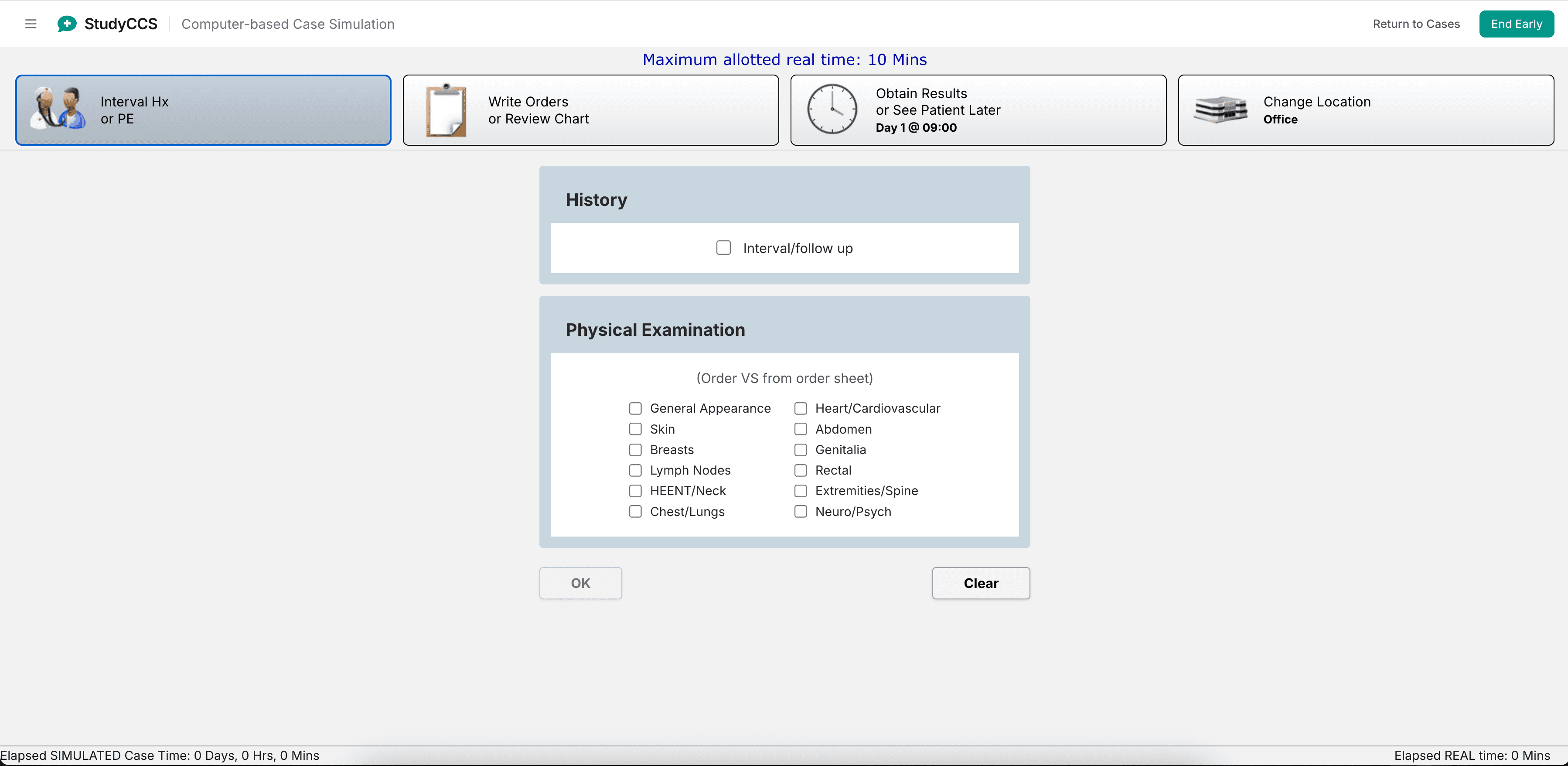
If you already own UWorld for Step 3, this is a fair question to ask before you spend money on anything else. UWorld is the default Step 3 question bank for a reason, and it does include CCS case simulations alongside the multiple-choice material. The honest answer is that it is enough to pass the CCS section for a lot of people, and it is not enough to stop worrying about the CCS section for most of them.
The distinction matters because the two halves of Step 3 fail you in different ways. Here is what UWorld covers well on the CCS side, where its reps run short, and how to decide whether you need anything beyond it.
What UWorld Does Well for CCS
- The underlying medicine. The QBank explanations are the strongest part of the product, and CCS cases are graded on clinical decisions. If your management knowledge is solid, a large share of CCS scoring takes care of itself.
- Format exposure. Its case simulations get you past the initial shock of the interface — free-text orders, the clock, location changes. That first encounter should not happen on test day.
- One-stop prep. Day 1 and Day 2 multiple choice plus some CCS practice in a single subscription is genuinely convenient, and convenience is a real factor when you are working clinical hours.
If you are comparing it against the other options on the market rather than against nothing, the CCS resource comparison puts the full landscape side by side, and what Reddit says about UWorld vs StudyCCS collects how people actually describe the gap after sitting the exam.
Where It Tends to Run Short
These are the complaints that come up consistently, and they are about reps and feedback rather than content quality.
- Order-writing speed. Knowing that a septic patient needs blood cultures before antibiotics is not the same skill as typing both orders in under ten seconds while the clock runs. CCS penalizes slow hands, and reading explanations does not train them.
- Breadth of chief complaints. A QBank built primarily around multiple choice will not give you a case for every presentation you might draw. The presentations you never rehearsed are exactly the ones that cost you.
- Full-case repetition. Most people work through the available case simulations once. CCS instincts come from running the same opening sequence enough times that it stops being a decision, which requires more full cases than a mixed-format product usually supplies.
- Scoring feedback on cases. A multiple-choice question is right or wrong. A CCS case is scored on sequencing, timing, and omissions, and it is hard to improve without being told which of those you fumbled. See how CCS scoring actually works for what is actually being measured.
How to Decide
Run this check rather than guessing.
- Sit one full CCS case under a real clock. Not a review, not untimed. One case, start to disposition.
- Score yourself on three things: did you place the critical order in the first 60 seconds, did you advance the clock at sensible intervals, and did you write the discharge and preventive orders at the end?
- Then judge. If you hit all three comfortably and finished with time to spare, UWorld is probably enough and your time is better spent on multiple choice. If you froze at the order screen, drifted on the clock, or ended the case without counseling and follow-up orders, you have a reps problem, and more explanations will not fix a reps problem.
The question of volume — how many cases is actually enough — is its own decision, and how many CCS cases you need for Step 3 works through it.
The Realistic Answer: Do Both, But Split Them by Job
Almost nobody who passes comfortably uses one resource for everything, and the split that works is by function rather than by brand.
- Use UWorld for knowledge. Multiple choice for both days, and read the explanations properly. That is what it is best at.
- Use dedicated CCS practice for mechanics. Timed full cases, repeated, across every presentation you could plausibly draw.
- Drill the opening sequence separately. Order-writing speed is a motor skill and deserves its own short, frequent sessions.
If you want the two products compared feature by feature rather than in the abstract, UWorld vs StudyCCS score predictor and StudyCCS vs CCS Cases go through the specifics.
For the mechanics half of that split, practice CCS cases gives you timed full-length reps, SpeedOrder trains order-writing speed on its own, and the Score Predictor blends your case performance with your multiple-choice data so you are not reading your readiness off a single source.