Most people take the NBME's free 137-question practice set, look at a percent correct, and move on. That wastes the most useful thing the form gives you: a clean sample of the question types that show up on Step 3 Day 1. Day 1 is not just a longer Step 2. It leans hard on biostatistics, pharmaceutical advertisements, ethics and communication, and a very particular "what do you do in the office versus the emergency department" style of question.
This page breaks the Free 137 down by item type and tells you how to attack each one. For the version map and which form to take, start at the Free 137 hub. For when to sit it and how to review it, see how to actually use the Free 137.
The item types you will meet
Across the four blocks, the questions sort into a handful of recognizable shapes. Learning to name the shape in the first few seconds is most of the battle.
- Biostatistics and epidemiology. Sensitivity, specificity, predictive values, number needed to treat, relative versus absolute risk, confounding, bias, and study design critique.
- Pharmaceutical advertisement items. You are shown a drug ad and asked what claim it actually supports.
- Ethics, communication, and professionalism. Capacity, consent, confidentiality, disclosure of error, impaired colleagues, difficult family conversations.
- Setting-dependent management. The same complaint, but you have to decide what happens in a clinic visit versus what happens in the ED.
- Pharmacology and adverse effects. Which drug caused this, and what do you change.
- Screening and preventive care. Age- and risk-appropriate screening, immunizations, counseling.
- Patient safety and systems. Root cause analysis, error types, quality improvement vocabulary.
Biostatistics: do the arithmetic, not the vibes
Biostats items are the most reliably winnable points on Day 1 because the answer is computable. The trap is trying to reason them out qualitatively.
- Draw the 2x2 table before you read the answer choices. Disease across the top, test result down the side.
- Label which margin the question is asking about. Sensitivity and specificity read down the disease columns; predictive values read across the test-result rows.
- Watch for prevalence changes. If the stem moves the test to a lower-prevalence population, positive predictive value falls and negative predictive value rises — sensitivity and specificity do not move.
- For risk questions, separate relative risk reduction from absolute risk reduction. Number needed to treat is the reciprocal of the absolute reduction.
Keep a running list of the formulas you had to look up during review. That list, not the percent correct, is your study plan for the biostats portion.
Drug advertisement items: the claim has to match the data
Drug ad questions look intimidating and are mostly reading comprehension with a statistics filter. The ad will make a confident marketing claim; the fine print will support something narrower.
Work it in this order: find the study design in the small print, find the population that was actually studied, find the outcome that was actually measured, then ask whether the headline claim follows. The correct answer is usually the most conservative statement that the data can bear. Common gaps between claim and evidence include a surrogate outcome standing in for a clinical one, a relative risk reduction presented without the baseline rate, a study population that does not match the patient in the question, and a comparison against placebo being sold as superiority over standard therapy.
Ethics and communication: name the principle first
These items reward a consistent framework rather than intuition. Before you look at the options, decide which question is being asked:
- Does this patient have capacity? Capacity is decision-specific and clinical. If the patient can understand, appreciate, reason, and express a choice, their refusal stands even when you disagree with it.
- Who decides if they cannot? Advance directive first, then the named healthcare proxy, then the surrogate hierarchy.
- What do I owe in disclosure? Errors get disclosed to the patient, plainly, without hedging.
- Is there a limit on confidentiality? Reportable disease, credible threat to an identified person, suspected abuse of a child or vulnerable adult.
Answers that involve talking to the patient directly, exploring their concerns, or gathering more information before acting tend to beat answers that escalate, override, or hand the problem to someone else.
Office versus emergency department
A large share of Day 1 stems hinge on where the patient is sitting. The same chest discomfort is a stress-test conversation in clinic and an EKG-plus-troponin pathway in the ED. When you review a miss, write down whether you got the medicine wrong or the setting wrong — they need different fixes. Setting errors are a habit problem, and they are the ones that carry over most directly into Day 2.
Turning a miss into practice
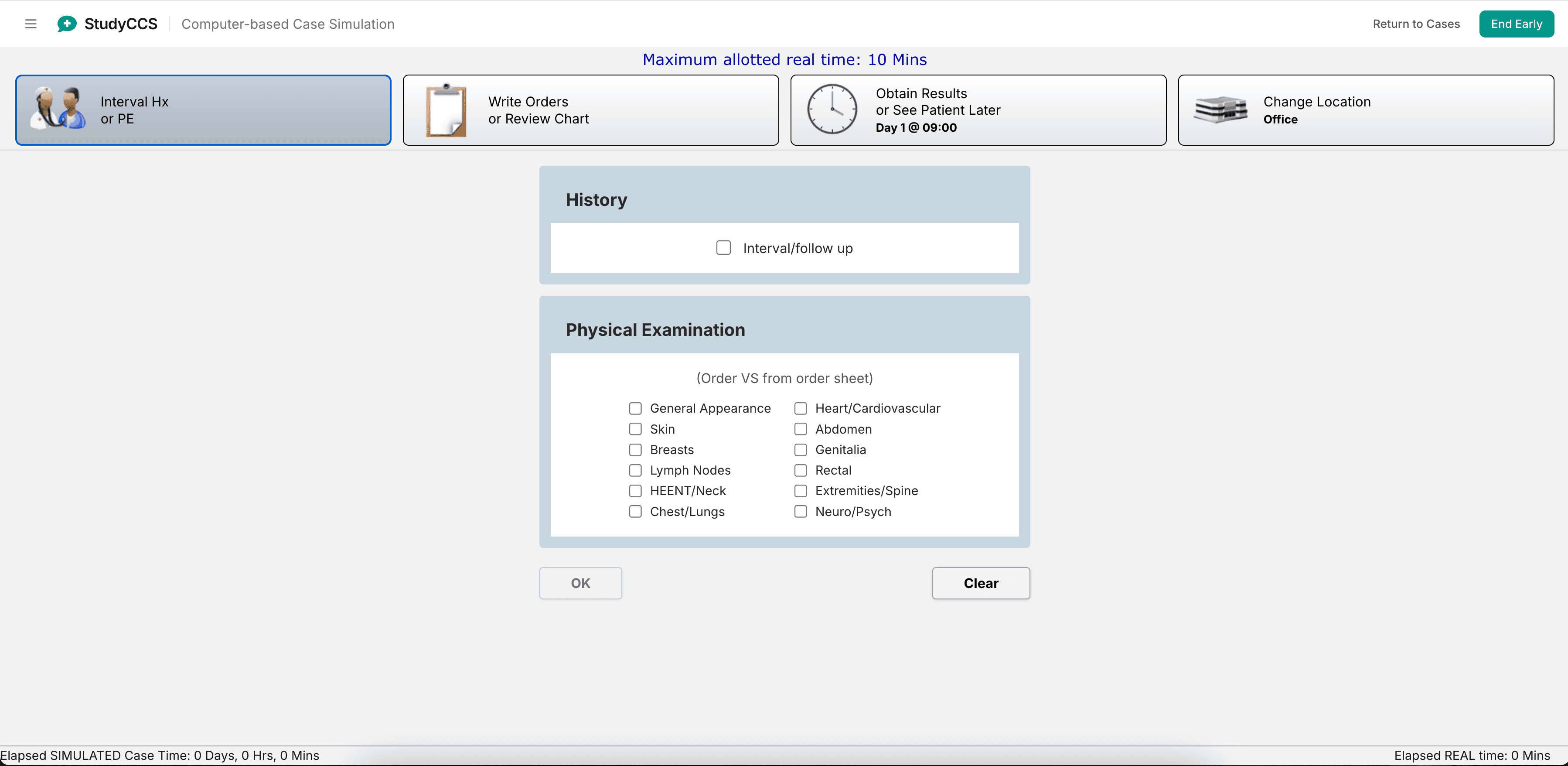
Every item type above is multiple choice, so none of them make you enter an order or pick a monitoring interval. That matters most when a stem is clearly case-shaped — unstable patient, next order, when to admit, what not to do. Reading the explanation on those items teaches you the answer; running the presentation teaches you the sequence.
Practical bridge: sit the current form in tutor mode on the Free 137 practice exam, tag the case-shaped misses, then run those presentations on CCS cases and drill the opening orders on SpeedOrder. If you want a readiness estimate that blends both halves of the exam instead of one practice set, use the Score Predictor.
A review pass that actually changes your score
- Sort every miss into one of the item types above. You are looking for a cluster, not a list.
- For biostats and drug ad misses, redo the calculation on paper until you can produce it without the explanation open.
- For ethics misses, write the one-sentence principle you should have applied.
- For setting misses, write the clinic plan and the ED plan side by side.
- For case-shaped misses, run the presentation as a timed case and check your order set against the CCS cheat sheet.
Two blocks of honest review on these lines is worth more than another archived form. If you do want more official multiple-choice volume afterward, the older sets on the hub are extra practice rather than a second real score.
Related guides: